About

Musoke Nalwoga is an independent curator, researcher, and founding director of MOTORMOND, an Amsterdam-based art space dedicated to circulating critically grounded Pan-Diasporic cultures. Nalwoga’s curatorial practice operates through a double movement, residing both inside and outside the art world, combining rigorous research with accessible, non-academic formats that remain embedded in and responsive to the communities she serves. From this vantage point, she engages with institutions and infrastructures to cultivate sustained and meaningful cultural exchange.
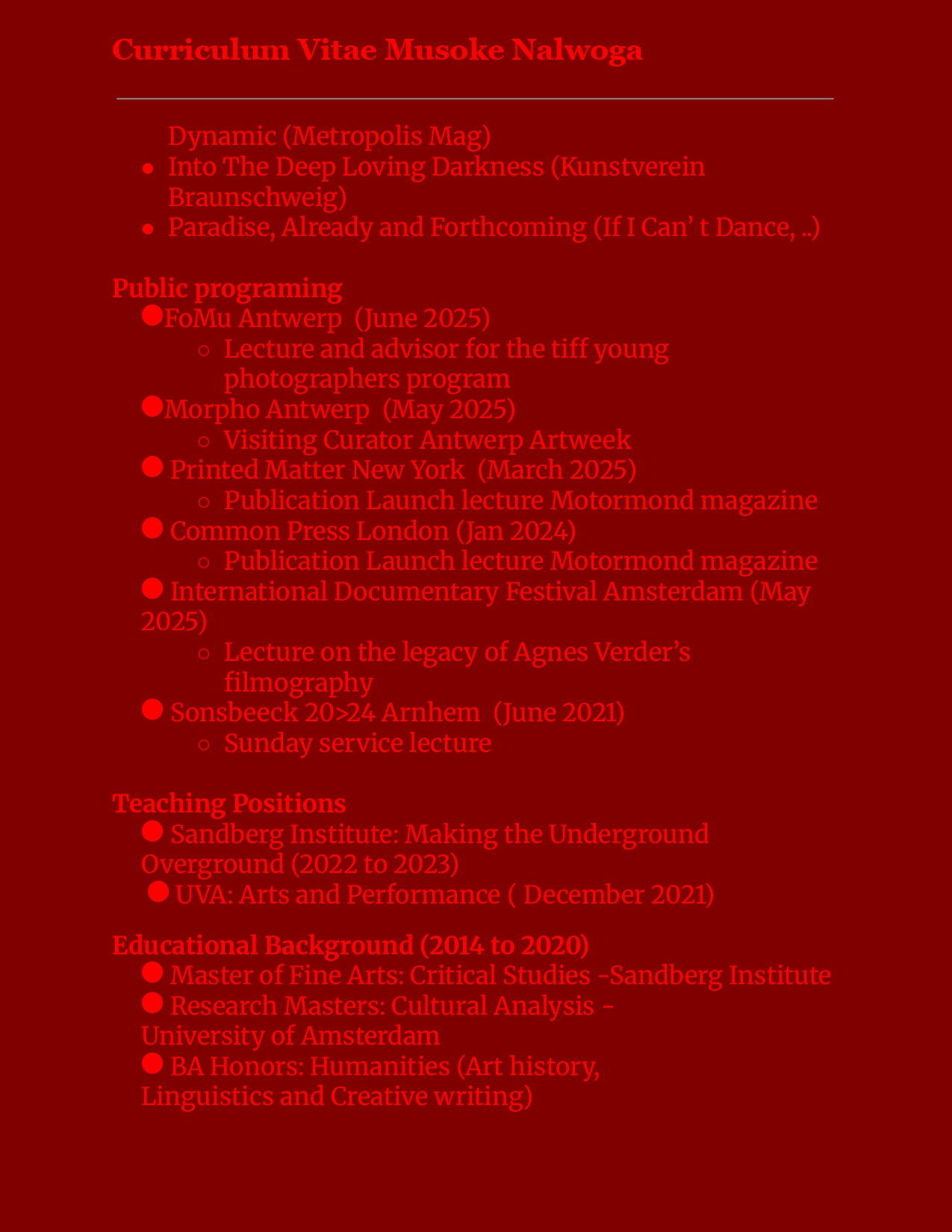
Nalwoga has recently been appointed co-curator of the 31st edition of the Noorderlicht Photography Biennale, taking place in fall 2027. She has collaborated with institutions such as Kunstverein Braunschweig, OSCAM, Framer Framed, and Vleeshal. She has also contributed to public programming at platforms including Printed Matter New York, FoMu Antwerp, and the International Documentary Festival Amsterdam, and has guest lectured at the Sandberg Institute and the University of Amsterdam.
She has participated in residencies and fellowships including the ICI Curatorial Intensive Kampala, the Morpho Antwerp Visiting Curator Program, the Mondriaan Fonds Orientation Trip to Spain and Portugal, The New Art School Modality in New York, and the A4 Foundation in Cape Town. Nalwoga holds a Master of Fine Arts in Critical Studies from the Sandberg Institute, a Research Master’s in Cultural Analysis from the University of Amsterdam, and a BA (Honours) in Humanities (Art History, Linguistics, and Creative Writing).